Reverse logistics in e-commerce

Reverse logistics in e-commerce

Controlling costs and recovering value

Published on 21/04/2022
Modified on 10/06/2026

With e-commerce on the rise, reverse logistics is more than ever a major challenge for e-tailers, both in France and in Europe. The challenge today is to control the costs involved in managing returns, and to accelerate these flows in order to ensure that returned products are put back on sale or recycled more quickly.

Executive summary

  • Reverse logistics is no longer just a customer service topic: it directly affects margin, stock availability and resale speed.
  • A good returns policy must balance legal compliance, simplicity for the buyer and strict control of operating costs.
  • The most effective levers combine returns prevention, self-service customer journeys and better warehouse visibility.
  • A WMS helps direct each returned item to the right outcome: restocking, repair, refurbishment, secondary sale or recycling.

After developing delivery solutions designed to optimize the customer experience, e-commerce players are now focusing their efforts on reverse logistics. But beyond customer satisfaction, the challenge for online retailers is also to meet their legal obligations.

Above all, a legal obligation

Under article 221-18 of the French Consumer Code, "consumers have a period of fourteen days to exercise their right of withdrawal from a contract concluded at a distance".

Compliance, however, is only one side of the issue. Retailers must also be able to receive the product, identify its condition, validate the return reason and trigger the right commercial response without creating operational bottlenecks.

An argument for customer satisfaction

This legal obligation is undoubtedly in the interests of customer satisfaction. Knowing that they have this freedom will encourage consumers to order more easily.

Today, the quality of the return experience also shapes brand perception. A clear return journey, transparent instructions and proactive status updates can reassure customers while reducing unnecessary contacts with customer service.

Costs not to be underestimated

Shipping costs for the first shipment, transport costs for the returned parcel, processing of the returned parcel, reshipment of a new product - these are just some of the costs involved in returning a product. Managing returns is therefore a highly strategic issue for e-tailers, as it represents a significant cost. To limit these costs, e-tailers need to simplify their returns policy as much as possible, and limit the number of interactions between the consumer and customer service.

Preventing returns is also part of reverse logistics

For many retailers, the best-controlled return is the one that can be avoided upstream. Richer product content, clearer sizing or compatibility information, better visuals and more reliable order preparation all help reduce avoidable returns before they enter the reverse flow.
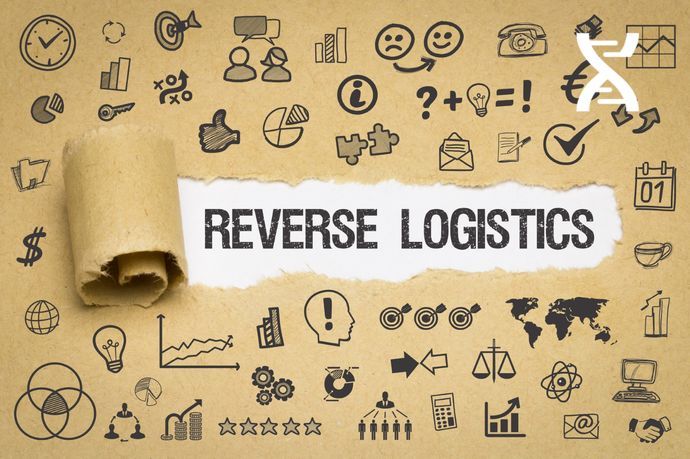
Reverse logistics is the management of flows linked to product returns. Mastering this process is essential to satisfy consumer demands and limit costs.

Managing returns is therefore a highly strategic issue for e-tailers

The main levers for optimization

Upstream organization

In order to optimize reverse logistics, it is first necessary to identify all possible upstream scenarios, and for each of them, to identify the appropriate solution.
In addition, to reassure buyers about the possibilities open to them in terms of returns, the company must define its guarantee conditions upstream, and facilitate access to this information for the end customer.

This upstream work also involves standardizing return reasons. Well-structured return data helps purchasing, quality, packaging and merchandising teams identify recurring causes and act on them.

Optimizing return flows and processes in the warehouse

To optimize return flows and processes in the warehouse, logistics platforms need visibility. However, the diversity of information systems adopted by each player in the supply chain contributes to hampering this visibility.

One of the current priorities is therefore to connect order management, transport, customer service and warehouse tools more effectively. The aim is simple: know where the parcel is, understand why it is being returned, and decide as early as possible whether the item should be restocked, inspected, repaired or redirected.

Reducing avoidable returns

Optimization does not start when the parcel comes back. It also depends on better product information, more accurate delivery promises, more robust packaging and easier access to support before purchase. Depending on the model, local drop-off points or in-store returns can also shorten loops and improve convenience.

Consumers expect retailers to offer a simple, effective returns policy that's just a click away.

The advantages of a WMS in optimizing reverse logistics

Deploying a WMS offers a number of advantages when it comes to optimizing reverse logistics. Here are just a few: real-time inventory management, increased reactivity, organization of stock placement, tracking of all internal and external logistics flows. The WMS is therefore an indispensable tool in supply chain management (SCM).

In more mature organizations, the WMS is also connected to order, transport and customer service systems so that statuses, controls and routing rules are shared in real time. This reduces manual handling and shortens the time between receipt of the return and the final decision.

Process acceleration

To optimize reverse logistics, it is essential to speed up product restocking. The longer a product remains in the system, the more its value is likely to decline. Conversely, the faster a product is returned to stock, the faster it can be reintegrated into a secondary sales channel.

Speed also depends on the ability to sort products on arrival. A simple grading logic can separate items that are immediately sellable from those requiring cleaning, repackaging, technical inspection or a secondary channel.

Inventory optimization

For a company, it's vital to work on inventory optimization. The aim is to avoid overstocking and understocking. Over-stocking penalizes investment in other areas. Conversely, under-stocking can lead to stock-outs and loss of sales. Having a clear view of inventory in the reverse flow enables you to avoid under- or over-stocking.

Choosing the right destination for each returned item

A returned product does not always go back to primary stock. Depending on its condition, seasonality and residual value, the best option may be immediate resale, refurbishment, repair, donation, a secondary market or recycling. The earlier this choice is made, the more value the company can recover.

Ecological responsibility dimension

Reducing environmental impact is an increasingly important aspect of returns management, and will undoubtedly become a real selling point in the years to come. Steps taken in this direction include the creation of local return channels, the reinjection of finished or semi-finished products into production processes (which limits the use of virgin raw materials and generates lower energy consumption), and the sale of reconditioned products from end-of-life goods.

This environmental dimension is increasingly linked to operational performance: shorter transport loops, better sorting and more refurbishment can both reduce waste and preserve product value.

Providing a return label for customers to print has become a reverse logistics staple.

Reverse logistics is a major commercial challenge for the retail industry, as it determines customer satisfaction and loyalty.

FAQ

  • What is the main goal of reverse logistics? To recover value from returned products as quickly as possible while controlling transport, handling and customer service costs.
  • Why is visibility so important in returns management? Because the sooner a retailer knows the reason, status and condition of a return, the sooner it can decide whether to restock, repair, refurbish or recycle the item.
  • Does a simple returns policy always cost more? Not necessarily. If it is well designed, self-service and supported by clear rules, it can reduce friction for customers while limiting manual processing.
  • What does a WMS contribute to reverse logistics? It centralizes stock visibility, helps structure inspection and routing workflows, and shortens the time needed to put returned goods back into a saleable channel.
Discover logistics software

Bext Logistics Software

The boom in e-commerce, omnichannel sales, changing purchasing habits and consumer expectations are all having an impact on logistics, and especially on warehousing, which is on the front line. BEXT WS frees you from unforeseen events such as stock-outs, discrepancies and picking errors; the solution optimizes your m2, your resources and digitalizes your processes for impeccable customer service.

Discover
Contact us